Autism Acceptance Month

It’s Autism Acceptance Month. Not Awareness. There’s a Difference, and It Matters.
Acceptance means embracing ALL of autism. Not just the parts that are easy to talk about, or the stories that feel inspiring and comfortable. All of it. That distinction matters more than most people realize, and it’s where we need to start.
Autism is legally recognized as a disability. Not every autistic person identifies as disabled, and that’s okay. But “disabled” simply means someone has different or additional access needs. The word isn’t an insult. Treating it like one is.
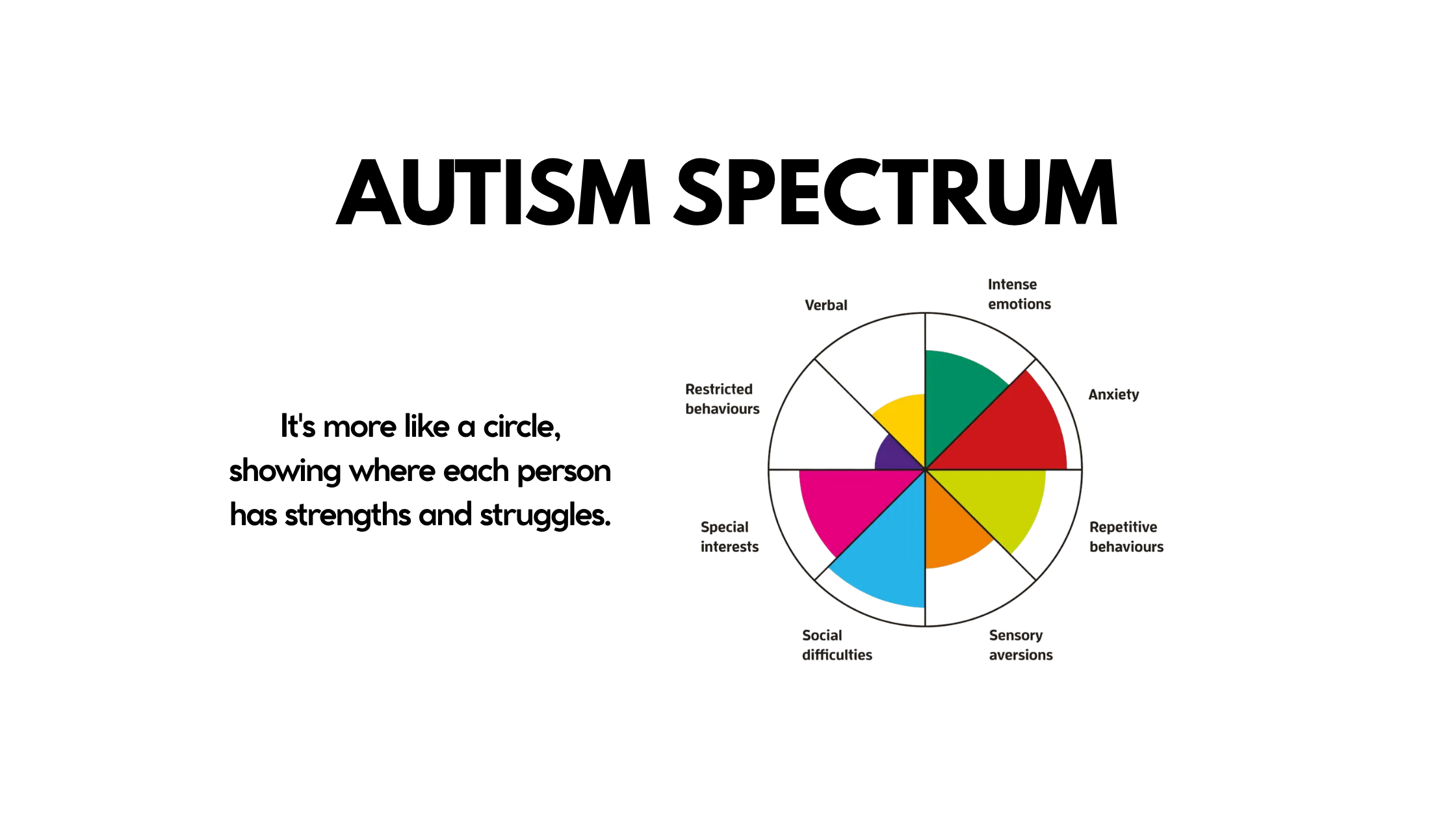
Now, when most people hear “autism spectrum,” they picture a straight line from “a little autistic” on one end to “very autistic” on the other. That’s not how it works. The spectrum is more like a circle, mapping where each person has strengths and where they struggle. Every autistic person looks different. There’s a saying in this community that captures it perfectly: “If you’ve met one autistic person, you’ve only met one autistic person.”
You may have heard of diagnosis levels. Level 1 requires support. Level 2 requires substantial support. Level 3 requires very substantial support. Not every place uses these levels, and they come with real problems in practice. Level 1 folks are often dismissed and assumed to need no help at all. Level 2 and Level 3 folks are often infantilized and denied autonomy. Every level deserves dignity, and that’s not up for debate.
Part of the reason so many people go undiagnosed or misdiagnosed comes down to who autism research has historically focused on: white men and boys. Autistic people who don’t fit that picture are frequently missed or diagnosed much later in life. That delay isn’t just frustrating. It comes with real costs to mental health.
One factor contributing to missed diagnoses is masking. Masking is when an autistic person hides or suppresses their traits to fit in. It can look like mimicking others, adapting behavior, or performing “normal.” It is exhausting. Over time, it can lead to anxiety, dysregulation, shutdowns and meltdowns, burnout, loss of identity, and deep confusion about who you even are underneath all of it.
There are also some myths worth addressing directly. Autism is not a childhood condition. Autistic children become autistic adults, and it doesn’t go away. Not all autistic people have a special gift or superpower. Some do, some don’t, and autistic people are not defined by what they can offer the world. And you absolutely can be autistic and still make eye contact, have friends, or seem “normal” to the people around you. Masking is real, and autism looks different in every single person.
While we’re at it, a few things worth retiring from your vocabulary: “You don’t look autistic” (autism doesn’t have a look), “everyone’s a little autistic” (no, they’re not, and saying so erases real experiences), and “they must be high-functioning” (functioning labels don’t tell the whole story and often do more harm than good).
Something else that often gets overlooked is that autism rarely comes alone. Many autistic people also experience ADHD, dyslexia, or other neurodivergent conditions, as well as chronic conditions like fibromyalgia, hypermobility, or EDS, and mental health conditions like depression, anxiety, or PMDD. Supporting autistic people means seeing the whole person, not just one piece of them.
Communication is another area where understanding goes a long way. Alexithymia, which is difficulty identifying or naming emotions, is common, sometimes meaning a person only recognizes a feeling long after it happened. Interoception differences make it hard to read the body’s own signals, like hunger, thirst, or a full bladder, which often go unnoticed until it becomes extreme. Dysregulation means reactions can feel bigger or longer than the situation seems to call for. Burnout, which can last three months or more, comes from chronic stress and unmet needs and includes exhaustion, loss of skills, and a lower tolerance for just about everything. Meltdowns are an outward, intense reaction. Shutdowns are an inward, powering-down reaction. Both are involuntary. Neither is a choice.
Routine matters too. Many autistic people genuinely thrive with sameness: same time, same order, same foods. Change can be truly hard, not just a preference or a quirk. Connected to this is something called monotropism, where attention works like a tunnel. When locked in, everything else fades, which is sometimes called hyperfocus. When something doesn’t engage that tunnel, starting it can feel nearly impossible.
Communication itself looks different across the autistic community. Some people are non-verbal. Some are hyper-verbal. Many are direct or literal. Some use Augmentative and Alternative Communication, or AAC, which ranges from no-tech options like gestures or drawing to tech options like tablets or speech-generating devices. Many autistic people struggle with small talk but can talk for hours about something that genuinely matters to them. Eye contact may or may not happen. All of it is communication, just not always the kind neurotypical culture has decided is “normal.”
And then there’s stimming: repetitive movements, sounds, or sensations used to self-regulate, process sensory input, and self-soothe. Rocking, spinning, humming, hair twirling, skin picking, blinking. It’s not a behavior to stop. It’s a tool.
Acceptance isn’t a month. It’s a practice. Learn, listen, and keep showing up.